However polished a procurement report is, a few things still need checking against the originals before anyone signs: what exactly did the committee approve? Was the cost direction in the spreadsheet read backwards? Is the scanned quote still valid?
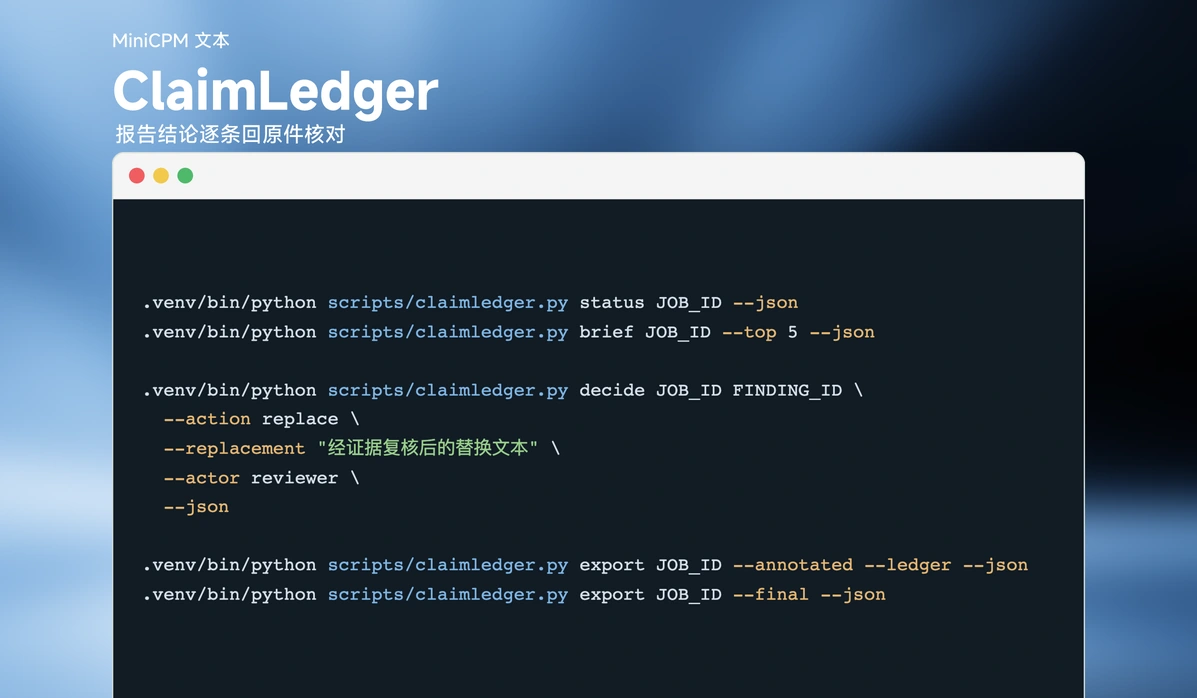
ClaimLedger is an open-source, local-first report evidence audit Skill. Give it a finished DOCX report and a closed bundle of local evidence. It splits the report into checkable claims, finds the supporting text in Word, Excel, PDF and scanned files, checks numbers, dates, units, entities and statistical scope, and lets a human decide how to handle each finding before it builds a traceable delivery package.
The author has published a MiniCPM5-2B integration plan, but the actual model integration, hardware and performance have not been verified yet. The author also states that the published demo video shows Qwen's office agent calling the Skill on an Intel PC, and those results should not be attributed to MiniCPM5-2B.
Example: Three Conflicts in a Procurement Report
The demo case covers an annual purchase of 12 million paper meal boxes with a budget of RMB 10.8 million. The report says supplier B gets a formal 70% share and saves RMB 1.68 million a year. Checked against the local working papers, three key claims fall apart:
| Claim in the report | What the evidence says | Result |
|---|---|---|
| The committee formally approved 70% for B | The minutes only approve a 30% trial for B; A keeps 70% | A trial was reported as a formal approval |
| Switching to B saves RMB 1.68M a year | TCO sheet 公式说明!C3 is RMB 721,600, defined as B's extra annual cost over A | Cost direction reversed; B actually costs RMB 721,600 more |
| All three quotes are valid until Sept 30 | B's scanned quote says Aug 31 | The quote has expired |
These are synthetic cases built from public problem patterns, de-identified and seeded with risks on purpose. They are not real customer files.
Where MiniCPM5-2B Fits
In the author's design, MiniCPM5-2B acts as a lightweight language layer: it understands the verification task the user describes in plain language, organizes the parameters and calls the claimledger-audit Skill as authorized. The rest of the work is split like this:
| Component | Responsibility |
|---|---|
| MiniCPM5-2B | Local task understanding, organizing intent, calling tools as agreed |
| ClaimLedger | Pre-checks and hashing, claim splitting, evidence retrieval, discrepancy checks, decision log, delivery gate |
| PaddleOCR | Recognizing scanned pages without a text layer, keeping page numbers and coordinates |
| Human reviewer | Deciding whether a risk is real, and whether to replace, reject or waive |
Numbers, dates and units are still checked against source text with deterministic rules. The model cannot invent file names, page numbers or quotes, and it does not make decisions for the procurement committee.
Core Flow
Report under review + closed evidence bundle
        ↓
Claims → Source evidence → Discrepancy checks → Human decisions → Delivery gate
        ↓
Annotated Word + Excel ledger + audit JSON + hash manifest + new Word version
- Parses DOCX reports and PDF, DOCX, XLSX, PNG, JPG and TIFF evidence.
- Every finding links back to a PDF page and coordinates, a Word paragraph or table cell, or an Excel sheet and cell.
- Flags source conflicts, weak support, outdated evidence and low-confidence OCR.
- Records SHA-256 for source files and formal outputs.
- Four decision types:
acceptonly confirms the risk and still blocks high-risk items;rejectandwaiverequire a reason;replacemust be re-verified. No final document is generated until high-risk items are resolved. - The local service listens on
127.0.0.1only; reports and evidence are not sent to the cloud.
Quick Start
git clone https://github.com/eason4kim-rocket/ClaimLedger.git
cd ClaimLedger/.qoder/skills/claimledger-audit
python3.11 -m venv .venv
.venv/bin/python -m pip install -e '.[dev]'

# Generate a synthetic demo case and audit it
.venv/bin/python scripts/claimledger.py demo --scenario operations --output ../../../demos/operations-local --json
.venv/bin/python scripts/claimledger.py audit \
  --report ../../../demos/operations-local/report.docx \
  --sources ../../../demos/operations-local/evidence \
  --case-name operations-local --rule-pack operations-zh \
  --profile deterministic --as-of-date 2026-08-05 --open --json
There are three modes: deterministic uses no generative model and suits first runs and tests; lite is for everyday local audits and uses PP-OCRv5 Mobile when needed; balanced must be enabled explicitly and uses local OpenVINO generation, retrieval and reranking models, with much higher memory use.
About the Numbers
demos/golden-v2/ contains three synthetic cases (procurement, operations, consulting) with 100 claims and 49 seeded risks. In lite mode the author reports 100% precision and 97.96% recall on risk detection, and 93% Top-5 recall for "file + exact quote + exact location" across domains. The author also notes that these are results on a specific synthetic dataset and should not be read as production accuracy.
ClaimLedger helps surface gaps between a report and its evidence. It does not replace the final judgment of a bid committee, a quality officer or legal professionals.
Links
- GitHub: eason4kim-rocket/ClaimLedger
- Original article (ModelScope, Chinese): MiniCPM5-2B × ClaimLedger
- Skill: claimledger-audit