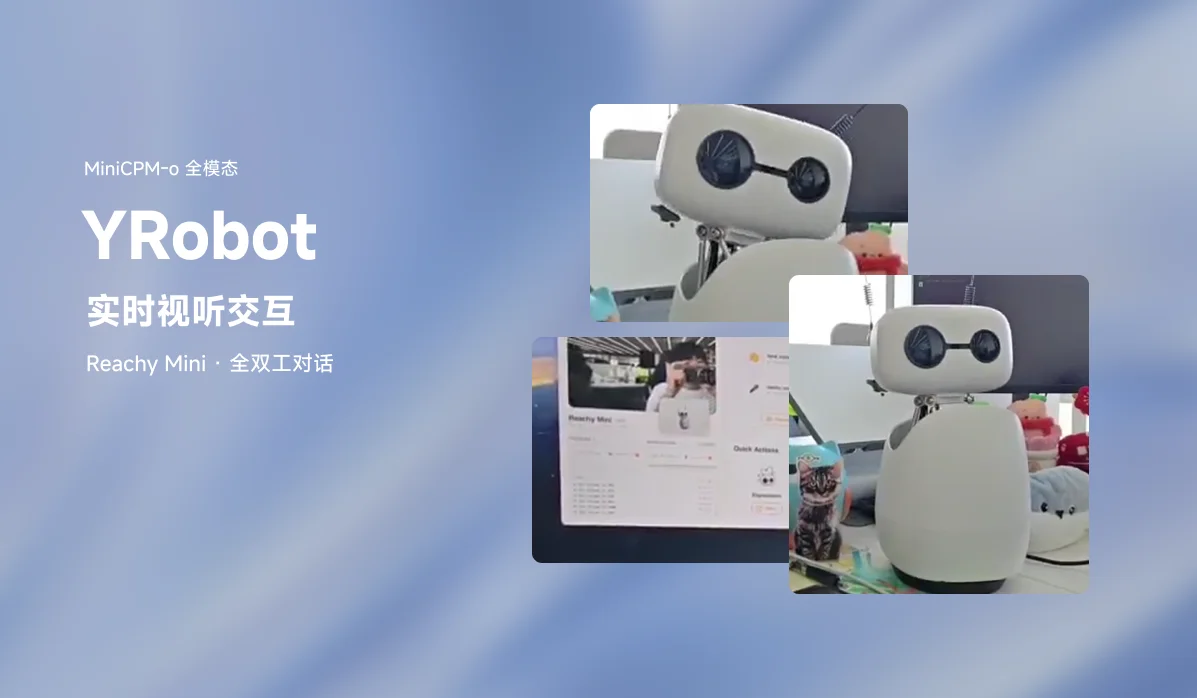
YRobot brings full-duplex, omni-modal conversation to Reachy Mini Wireless, powered by the MiniCPM-o 4.5 realtime API (docs).
The robot listens, watches, speaks and moves at the same time: you can talk over it and it hard-stops the interrupted turn after a locally qualified onset, it turns to face whoever is speaking, and it breathes, glances and dances its antennas while it talks.
you ─── voice ─► tuned XVF3800 AEC ─► 20 ms VAD/control ─► 1 s model units ──┐
      camera ─► continuous scene-aware latest-only JPEG worker ───────────────┤
                                                                              ▼
                                wss://…/v1/realtime?mode={audio|video}
                                                                              │
◄── lifelike motion ◄─ 50 Hz choreographer ◄─ DoA compass                    │
◄── speech          ◄─ epoch-tagged speaker ◄─ 24 kHz audio deltas ◄─────────┘
Why it feels responsive
Everything below is encoded in the source with the reasoning attached; this is the map.
| Problem | Mechanism | Where |
|---|---|---|
| Reply latency | Mic/VAD never waits for camera encoding or WebSocket sends. Audio enters a bounded realtime queue; video is latest-only. The MiniCPM-o stream uses its native complete one-second inference units, while adaptive 0.25–0.8 s playback preroll absorbs server jitter | main.py, audio.py |
| Barge-in | Client-owned and destructive: clear near-end speech takes a high-confidence 140 ms path; ambiguous double-talk takes the conservative 500 ms path. A commit advances the playback epoch and calls SDK clear_player(), so interrupted audio cannot replay. Complete one-second inputs then carry force_listen until the model returns to listening | barge.py, turn.py, main.py |
| False triggers from its own echo/motors | Every candidate is compared with exact recently scheduled speaker PCM. Echo similarity, unexplained energy and cheap speech-shape checks gate the fast path; head bumps and uncertain residuals must survive the safe path. A 40 ms gap tolerance handles XVF double-talk suppression | barge.py, audio.py |
| Wooden motion | One 50 Hz thread owns the pose. Breathing and posture cross-fade; gaze and idle saccades use velocity-limited second-order trajectories. A slower body-yaw spring follows sustained physical head direction—including daemon-side face tracking—while leaving small head gestures independent | motion.py |
| Deaf DoA | Samples are gated by locally confirmed user voice, transformed with the daemon's physical head pose, confidence-weighted with the XVF speech flag, circularly averaged, and dead-banded | motion.py, main.py |
| Visual blindness / context rot | Camera capture continues while either side speaks and stays alive across Gateway rotation. Conversation frames publish at 1 fps; idle frames publish on scene change plus a 3 s heartbeat, always latest-only. Video sessions rotate before the 300 s cap at a quiet boundary and carry a bounded assistant-side continuity hint; capture, send and true handoff gaps are logged | vision.py, session.py, main.py |
| Generic voice / passive behaviour | Optional LLM and TTS reference WAVs use the documented session.init.voice fields. Video mode also adds a restrained proactive-observation policy; both features are explicit environment settings | config.py, realtime.py |
Protocol in one paragraph
Connect to wss://HOST/v1/realtime?mode=audio for voice-only or mode=video for camera input, wait for session.queue_done, send session.init (the system prompt must start with the trained line You are a helpful assistant. — a free-form persona drifts the model out of its duplex distribution), wait ~14 s for session.created, then stream complete input.append inference units: exactly 16,000 base64 float32 16 kHz mono samples (one second), a unique input_id, optional force_listen, and—only in video mode—base64 JPEG video_frames. The server streams response.output.delta events whose kind is listen, text or audio (audio is 24 kHz float32); only listen is an utterance boundary — text and audio are independent streams. YRobot uses input_id for strong local causality when the gateway echoes it; because the public protocol does not require that echo, it also has a guarded fallback: an untagged listen is accepted only after the latest forced packet has actually crossed the socket and no newer voice has appeared. See realtime.py and turn.py.
Run
On the robot (Python 3.12 venv on the CM4), or any machine that can reach the daemon:
pip install -e .
cp .env.example .env   # optional; the default already uses the official public Gateway
yrobot
The shipped default is the official public Gateway at wss://minicpmo45.modelbest.cn/v1/realtime?mode=video, with continuous frames; it does not require a locally deployed model Host. Voice-only mode is an explicit fallback: use mode=audio, set YROBOT_SEND_VIDEO=0, and proactive vision is disabled automatically. Optional reference-voice and tuning variables are documented in .env.example.
It also registers as a Reachy Mini app (reachy_mini_apps entry point yrobot), so the dashboard can start and stop it. While the app is running, use its settings icon to change the Gateway, TLS verification, continuous video, proactive observation and the one-line persona. Dashboard values are stored in ~/.config/yrobot/settings.json; daemon/process environment variables take precedence, and saved changes apply after restarting YRobot.
Development without hardware:
pip install -e ".[dev]"
pytest && ruff check .
Before publishing to the Reachy Mini app store, also run:
reachy-mini-app-assistant check .
The automated checks do not replace the Wireless hardware acceptance gates in plan.md.
Privacy
YRobot processes microphone and camera input off-device:
- While the app runs, 16 kHz microphone audio is streamed to the configured MiniCPM-o realtime Gateway.
- In video mode, JPEG camera frames are also transmitted—about 1 fps during conversation, with scene-change delivery and a bounded idle heartbeat. Selecting audio-only mode in the settings page disables camera transmission.
- YRobot does not write microphone recordings or camera frames to local storage. Remote processing, retention and access are governed by the operator of the Gateway you select.
Review this disclosure before running the app around other people, and obtain any consent required in your location.
Layout
yrobot/config.py     env → one frozen Settings dataclass; URL normalization
yrobot/app_config.py dashboard settings API + atomic per-user persistence
yrobot/realtime.py   gateway protocol client + <think>-leak filter
yrobot/turn.py       barge-in state machine (pure logic, fully unit-tested)
yrobot/audio.py      mic framing, VAD stack, 24→16 k resampler, epoch speaker
yrobot/barge.py      echo-aware fast/safe acoustic barge-in qualification
yrobot/vision.py     continuous scene-aware, latest-only camera worker
yrobot/session.py    quiet-boundary rotation + bounded continuity memory
yrobot/motion.py     DoA sound compass + 50 Hz choreographer
yrobot/main.py       wiring, session rotation, ReachyMiniApp + CLI
yrobot/static/       Reachy Mini dashboard settings interface
Every module docstring states the non-obvious constraint it encodes (gateway behaviour verified live, SDK threading rules, XVF3800 quirks). If you change a number, read the docstring above it first.
Links
- GitHub: thomas-yanxin/YRobot
- MiniCPM-o 4.5 realtime API docs: minicpmo45.modelbest.cn
Built by thomas-yanxin. Licensed under Apache-2.0.