A full-duplex voice appointment desk on MiniCPM-o 4.5, vanilla weights. The speech model keeps listening and talking; a reasoning LLM and a deterministic state machine behind it run the tools (check, book, cancel) and write a short operator screen that the speech model reads through its vision input, every second, like an operator reading the CRM. A judge catches false claims. No fine-tuning, no turn-taking: the reasoning never sits in the audio path, and the caller never waits for a turn.
This branch: vision-booking. The operator screen is rendered as a frame and sent through the model's video input. The sister branch text-booking sends the same screen as plain text in the vision slot, with no image encoding, and behaves the same. The two branches differ only in that channel.
Demo (3 minutes)
▶ Demo video: booking and cancelling with real interruptions, database on screen
Recorded on one RTX 5090 (32 GB), headset, English, no editing inside a conversation.
Where this sits
MiniCPM-o 4.5 is the front model here because it is open, runs on one consumer GPU, and exposes the two hooks this design needs (a per-unit speak/listen decision and a KV cache that can be windowed). It is not the last word in full-duplex models: DuplexOmni (Huang et al., 2026, arXiv:2606.09186) puts real-time thinking next to listening, seeing and speaking inside the model, and looks like a stronger base for this kind of agent. Paper review: DuplexOmni: Real-Time Listening, Seeing, Thinking, and Speaking for Full-Duplex Interaction (YouTube). Nothing below depends on the front model beyond those two hooks, so the orchestration should carry over.
What it does
The customer talks to the desk. The desk asks for month, day and time, checks the calendar, proposes a slot when the customer says "you pick", books only after an explicit yes, and cancels an existing booking, again only after a yes. The bookings database is visible on a second page and is written by code only, never by a model.
How it works
Three channels, each used for what the model was trained on:
- Audio is only the customer. No synthetic voice, no injected audio. The model's natural trigger to speak is acoustic.
- Vision is the operator screen. Two or three lines, all of them sentences the operator can say to the customer as they are (
BOOK: APRIL/WHICH DAY?;APRIL 20, 2 PM/FREE/SHALL I BOOK IT?;BOOKED/ANYTHING ELSE?). Never an instruction to the operator: with a forced turn the model reads the screen literally, soSAY: AVAILABLEbecame "I'm going to say available". The screen is state, not a message: it updates while the model keeps talking, and the model reads whatever is there when it decides to speak. - Control tokens are the "when". Upstream has
force_listen; the author added its mirrorforce_speak(MiniCPMO45/modeling_minicpmo_unified.py): at the first decision of a unit with a closed turn,<|listen|>becomes<|speak|>and decoding continues normally. Measured: the turn opens in 0.5–1.2 s in 11 cases out of 12.
The loop for each customer line:
- Browser VAD closes the line (300 ms of silence) → Whisper large-v3-turbo transcribes it → the extractor (a small cloud LLM,
google/gemini-3.5-flash-lite, OpenAI-compatible endpoint) emits one event:set(values said, never writes),yes(the only event that writes, and it must quote the words that accept),no,cancel. - The state machine (
gateway.py) merges the record, validates the fields, checks the day or the month on the DB, proposes a slot on "you pick", books or cancels only onyes, and is idempotent (same record, no event). - The screen changes; the model answers from the voice and reads the screen, 1.5–3 s after the customer's line.
- At the end of each model turn (and 3 s after a customer line with no answer) the judge (same LLM, whole conversation + screen + state + timings + the desk's contract) returns
okorstuck(silent, off context, repeating, ignores screen, false claim, cannot do), a help line to say, and the claims it heard. - Claims are verified by code on the DB, never by the LLM: "I've booked it" before a yes → red
NOTHING BOOKED YET; "3 pm is free" when it is taken → red3 PM IS TAKEN. Stuck or red → the help line goes on the screen and the next chunk carriesforce_speak, so the model opens a turn and says it. - Guards, all measured on live runs: one help between two customer lines, at most two per state, 6 s between forces, stale verdicts dropped if the machine changed meanwhile, never a force in the first 3 chunks or while a turn is open. A judge check also runs mid-turn: a turn that lists days or loops is cut at ~11 s with
force_listen, then corrected. - The KV cache is windowed per session (basic, 4000 → 3500 tokens, system prompt preserved): upstream lets it grow to the model limit and the conversation dies after a few minutes.
Results, in numbers
Reference live sessions (recorded run registries, timings from the logs):
| session | length | bookings written | wrong writes | judge forces | reds | notes |
|---|---|---|---|---|---|---|
sess_20257233a096 (8 Sep) | 4 min 13 s | 2 (April 4 3 PM, November 15 6 PM) | 0 | 4, all justified | 0 | "you pick" proposed a day, mid-turn check let a healthy 12 s turn finish |
sess_f0ab8867fc79 (7 Sep) | 2 min 43 s | 1 | 0 | 3, all justified, 0 false on fillers | 1, corrected by voice within 1 s | month lookup read once, partial day read with the right polarity |
Latencies on those runs: extractor 1.0–1.4 s, judge 0.8–1.2 s, forced turn opens 0.6–0.7 s after the chunk, model reads a new screen 1.5–3 s after the customer's line. Screen frames: 448×448, one per second.
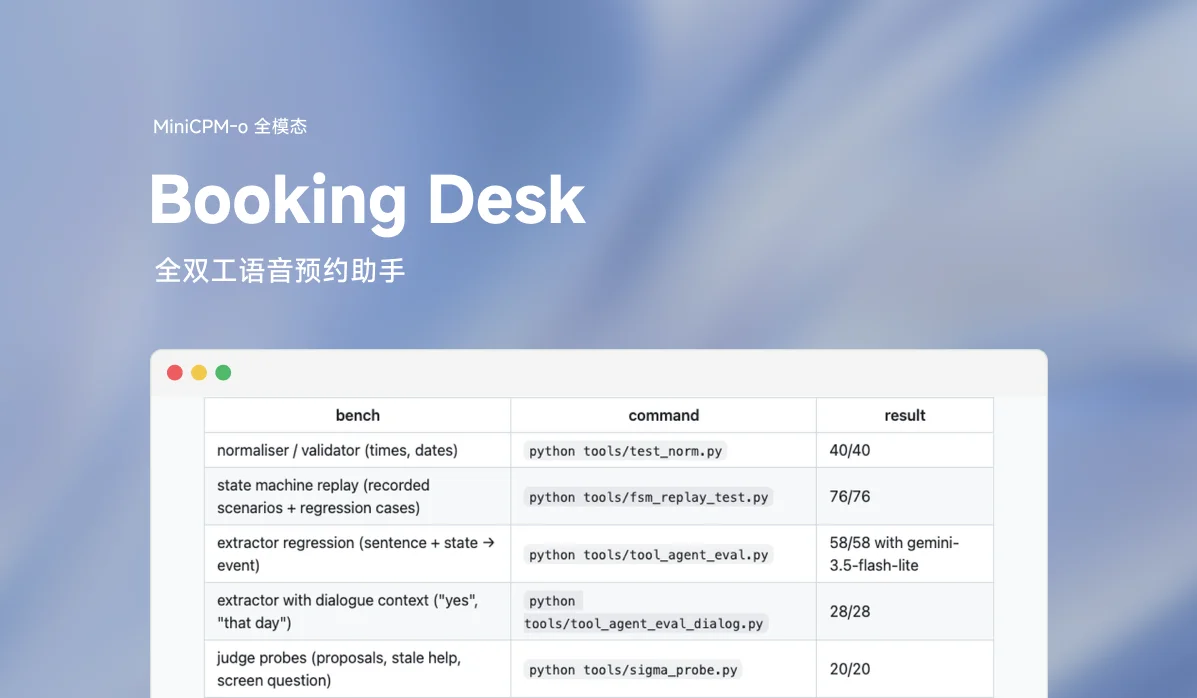
Benches (no GPU needed for the first two):
| bench | command | result |
|---|---|---|
| normaliser / validator (times, dates) | python tools/test_norm.py | 40/40 |
| state machine replay (recorded scenarios + regression cases) | python tools/fsm_replay_test.py | 76/76 |
| extractor regression (sentence + state → event) | python tools/tool_agent_eval.py | 58/58 with gemini-3.5-flash-lite |
| extractor with dialogue context ("yes", "that day") | python tools/tool_agent_eval_dialog.py | 28/28 |
| judge probes (proposals, stale help, screen question) | python tools/sigma_probe.py | 20/20 |
Three alternatives were measured for the extractor and not taken: a constrained-decoding local Qwen3-1.7B (44/55 against 47/55 free; it invents values to fill the JSON), Nemotron 3 Nano (48/58 at 1.2 s against 52/58 at 0.9 s for flash-lite, before the harness fix), Claude Sonnet 5 (+3 points, 2.5 s per call, too slow for the loop).
What failed, and what it taught
The full account is in docs/WRITEUP.md. The short list:
- Screens alone never woke the model (every session up to 6 Sep): a frame is not a trigger to speak. Hence
force_speak; not a longer prompt, not a banner, not synthetic audio. - Text injected in the model's output slot is spoken as its own words ("do you like cats" → "I like cats"); text in the system region is background, not an order. Hence the screen goes through perception.
- A timed policy (force on every event frame, latch, 3.5 s watchdog) talked too much and answered twice. Replaced by the judge, which decides from the conversation.
- Operator instructions on the screen are read literally. Only customer-facing sentences survive.
- Native tool calling on MiniCPM-o 4.5 does not work: the tokenizer has the Qwen3
<tool_call>template, but the model invents the answer instead of calling (3 probes). Hence the separate extractor. - An explicit STUCK state in the machine (13 Sep) made things worse: forces beat the caps and the model talked on its own. Dropped; the judge's help line plus guards is the working shape.
Limits
- The decision granularity is 1 s (one unit), so every correction lands in the next second, not the next 100 ms.
- English only. The prompt is one line: "You are in duplex mode, where you can listen and speak at the same time. You are the operator of an appointment booking desk. Follow the instructions on the SCREEN, always repeat dates for confirmation."
- Headset required: there is no echo cancellation between the model's voice and the microphone.
- Make sure to be at the right distance from the mic: not too close and not too far, based on the mic you have.
- The extractor and the judge are cloud calls (OpenAI-compatible endpoint); a local Qwen3-1.7B fallback exists and scores lower (48/55).
- Occasional non-English phonemes after fillers on very short turns, from the speech decoder; accepted.
Running it
Hardware: one GPU with 32 GB (tested on an RTX 5090 under WSL2; ~29 GB used with the turbo profile).
Software: Python 3.10, PyTorch with CUDA, pip install -r requirements.txt, plus openai-whisper for the side ASR (same environment, or another one through ASR_PYTHON).
- Weights:
models/MiniCPM-o-4_5from openbmb/MiniCPM-o-4_5. Optionalmodels/Qwen3-1.7Bfor the local extractor fallback (HUD_ASR=small). - Extractor / judge endpoint, in
~/.config/tool_agent.envor.envin the repository root:Plain TextTA_API_KEY=...TA_BASE_URL=https://api.cline.bot/api/v1 # any OpenAI-compatible endpointTA_MODEL=google/gemini-3.5-flash-lite - Launch everything (backend, side ASR, extractor/judge, worker, gateway; the backend loads in ~4 min):
Bashbash tools/run_desk.sh
- Open
https://localhost:8006/static/hud/hud.html(self-signed certificate), put on headphones, choose the microphone, press Start session. The bookings are athttps://localhost:8006/static/hud/db.html. - Read a run afterwards:
python tools/hud_run_log.py --conv(registry inlogs_demo/hud_runs/).
The HUD page also shows the state graph, the last judge verdict, the forces and the frames sent, and offers a manual request panel (no voice) to drive the machine by hand.
Repository map
| path | what |
|---|---|
gateway.py | upstream gateway + the desk: state machine, bookings DB, screens, judge routing (_hud_*, from line ~750) |
static/hud/ | operator screen page (hud.html, hud-app.js), bookings view (db.html) |
tools/tool_agent_server.py | extractor + judge service (cloud or local) |
tools/asr_server.py, tools/switch_asr_profile.sh | side ASR (Whisper) and its profile |
tools/run_desk.sh | launcher |
MiniCPMO45/ | upstream model code with the author's changes: force_speak override, per-session KV sliding window (set_sliding_window, window_stats), text injection hooks, decoder fixes (temperature applied to chunk end, repetition-penalty sign, <|listen|> token id, word-aligned chunk cuts) |
core/, py_backend/, static/duplex/ | plumbing of the new session fields (force_speak, sliding_window_*) |
tools/*_eval*.py, fsm_replay_test.py, sigma_probe.py, test_norm.py | benches above |
docs/WRITEUP.md | what worked, what failed, with numbers |
docs/UPSTREAM_README.md, docs/en/ | the original demo system's README and docs |
Links
- GitHub: AlessandroBonomo28/Minicpm-o-booking-desk
- Demo video: YouTube
Built by AlessandroBonomo28 on top of OpenBMB/MiniCPM-o-Demo (base commit 50b0865) and the MiniCPM-o 4.5 model. Whisper by OpenAI. The desk, the screens, the judge and the model changes are this repository's work.