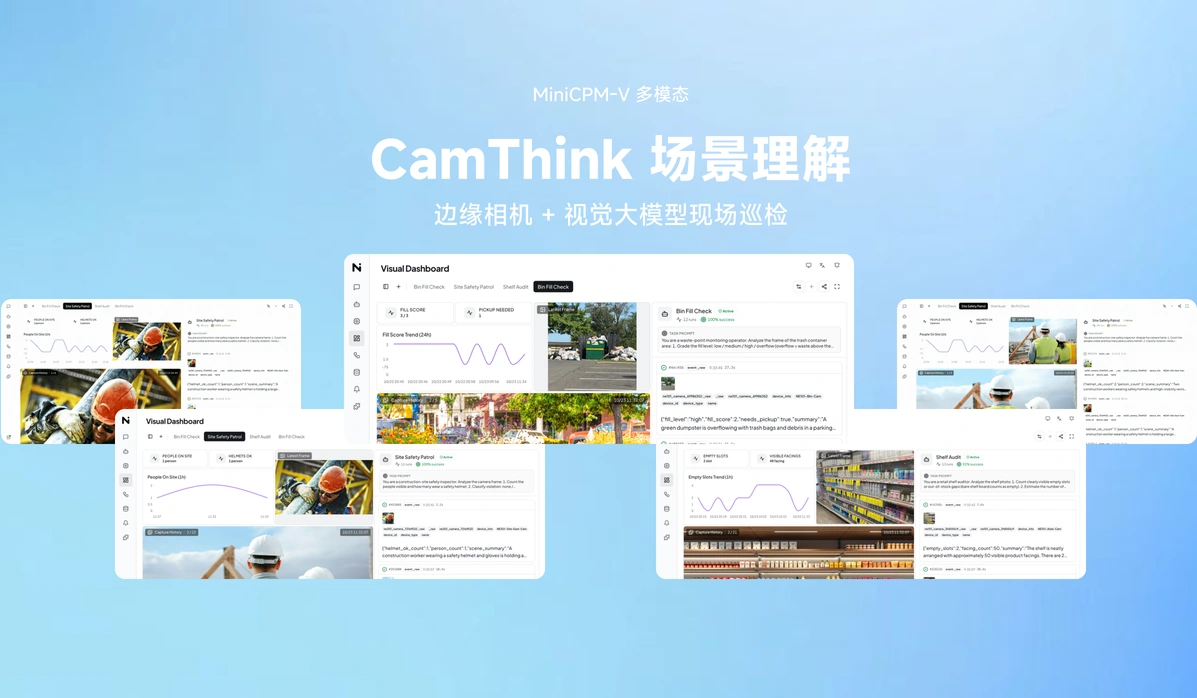
An edge vision solution from CamThink: on-site cameras capture images, an AI Box on the local network has a vision LLM "read" each frame according to a prompt, and the results become structured data you can chart and alert on. The default local vision model is MiniCPM-V 4.7 1B, so images and results never leave the premises.

Why Not Fixed Models
The most common way to deploy vision AI on site is one model per target: OCR for meter dials, YOLO for hard hats, face recognition for staff. These deliver high accuracy and low latency, but have two inherent limitations:
- One target, one model. Moving from "detect hard hats" to "judge whether they are worn correctly" means a new round of data collection, labeling, training, quantization, and deployment. Long-tail scenarios never get cheaper.
- Recognizes but never understands. Fixed models output classes and bounding boxes. They can't answer "what is happening on site", "is there any risk", or "what should be done".
Cloud vision APIs solve understanding, but images leave the intranet. In factories, farms, and warehouses, sending raw footage out often fails security review, on top of per-call billing and external dependencies.
How It's Built
- Cameras: one CamThink NeoEyes camera per point. NE101 runs on 4×AA batteries for years; NE301 has 0.6 TOPS on-device to filter with a local detector before upload; NE302 is a mini magnetic-mount module. They capture on schedule or by event and report over MQTT via Wi-Fi, Cat.1, or PoE.
- Host: one NG4500 AI Box per site running the NeoMind platform for device ingestion, image storage, Agent orchestration, time-series storage, and dashboards.
- Vision model: local, cloud, or both. Local keeps data on-premises; cloud reasons more strongly. Each Agent binds its own backend.
A starter setup is 3–5 cameras + 1 NG4500 + one local vision model. Adding points only means adding cameras.
The whole pipeline is three steps: camera captures → LLM interprets per prompt → structured fields land in the store and on dashboards.
What MiniCPM Does
MiniCPM-V-4.7-1B is in NeoMind's built-in model catalog as a dedicated vision model: 0.7 GB, official Q4_K_M quant + F16 projector, resident alongside the main model. One click on the Built-in Model card downloads it, and the platform spawns a llama.cpp vision instance with Multimodal enabled, zero configuration. AI Chat can then take uploaded images, and vision Agents can bind it to analyze camera footage.
If Ollama is already deployed, ollama pull minicpm-v works too. For stronger reasoning, bind individual Agents to a cloud model. A common setup: local small model for routine inspection to control cost, cloud model for anomaly review to ensure quality.
In the demo environment, the local 1B vision model completed 5 consecutive runs, 8–10 seconds each.
The solution and demo figures above come from CamThink's official documentation. Recognition quality depends on prompts, image clarity, and model capability, so validate on site before go-live. LLM judgments are probabilistic; keep a human review channel for business-critical decisions.
The Prompt Is the Task
Create a Structured Agent on the Agents page, bind a camera, and define output fields. For site safety:
| Field | Type | Description |
|---|---|---|
| helmet_count | Number | People wearing hard hats in the frame |
| violation | Enum: none, no_helmet, no_vest | Violation type |
| scene_summary | Text | One-sentence description of site activity |
Then write a prompt:
You are a site safety inspector. Analyze the workers in the frame:
1. Count the people present and those wearing hard hats;
2. Classify violation: none / no helmet / no reflective vest / multiple;
3. Describe the site activity in one sentence (what is happening, any risk);
4. If lighting is poor or people are too small to confirm, output none for
   violation and note "insufficient image conditions" in scene_summary.
   Never guess.
Each new frame triggers analysis. Output passes schema validation and lands as ai:{agent_id}:{field} virtual metrics in the time-series store, ready for dashboards. Every run archives the original capture and full reasoning JSON for auditing.
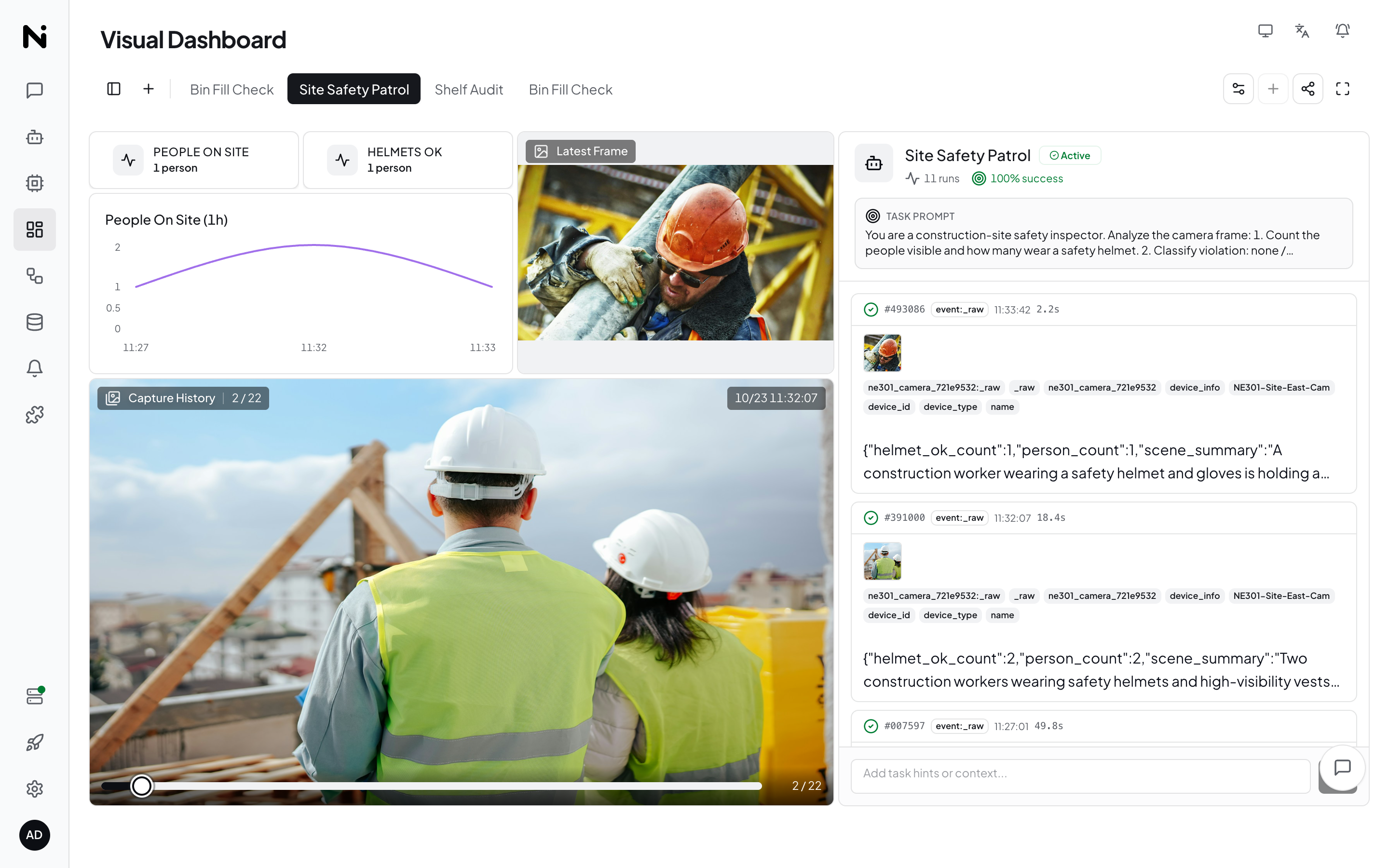
The same pipeline with a different prompt and fields becomes a retail shelf audit or a bin overflow monitor, with no retraining:
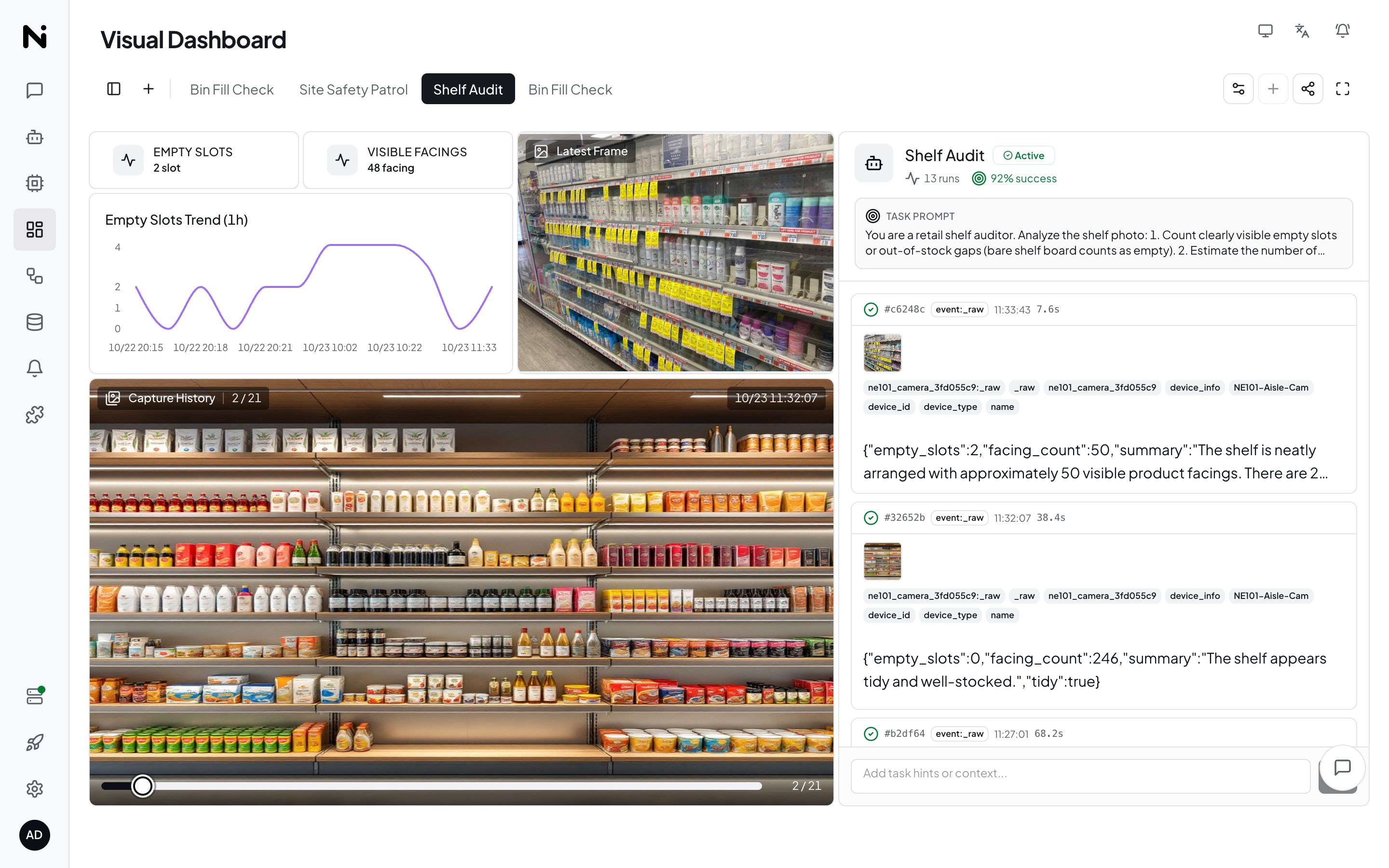
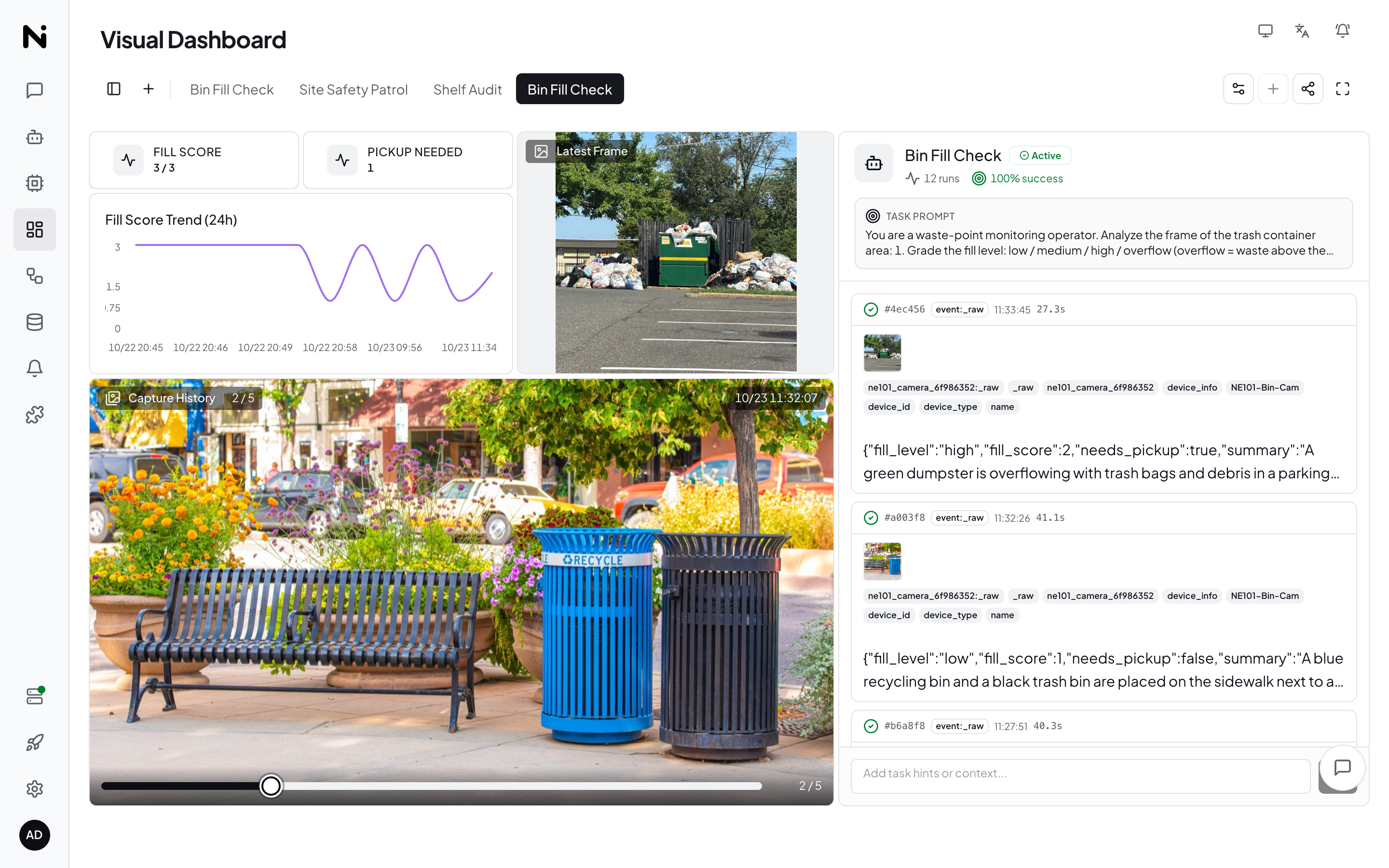
For prompts, the docs recommend three things: role, judgment criteria, and output requirements, plus explicitly allowing "uncertain" to suppress hallucination. Too many false positives: tighten the criteria. Too many misses: relax thresholds or capture more often.
Where It Fits
This doesn't replace OCR or YOLO. It covers what they can't: changing targets, open questions, and cases where sampling every few seconds to minutes is enough.
| Scenario | What the model judges |
|---|---|
| Site / workshop inspection | Hard hat and workwear compliance, unsafe work |
| Retail shelf audit | Tidy display, out-of-stock gaps |
| Bin / silo overflow | Fill level grading, threshold alerts |
| Meter / screen review | Reading verification, needle position, warning lights |
| Agricultural inspection | Growth description, abnormal behavior, health screening |
| Entrance status | Door closed or not, obstructions, foot traffic |
High-frequency fixed detection can run first as a YOLO filter on the NE301, triggering the Agent only on hits, balancing cost and depth.
Links
- Solution description: Vision LLM Scene Understanding
- Engineering guide: selection, networking, setup, integration, operations