Why
At a parcel pickup station, you have the pickup code on your phone, but the shelf is rows of identical boxes, each with a near-identical white label. You check them one by one, left to right, top to bottom:
- It's right in front of you and you still miss it. Two passes later, it turns out to be where you looked first.
- Four-digit codes blur together.
5726vs5762,3387vs3897. Scan too fast and you misread or skip. - Multiple parcels make it worse. Each one means starting over, with a queue behind you.
People are bad at finding one specific number among many similar ones. Reading every label and comparing it against a target is exactly what a model does well, without getting tired.
What It Does
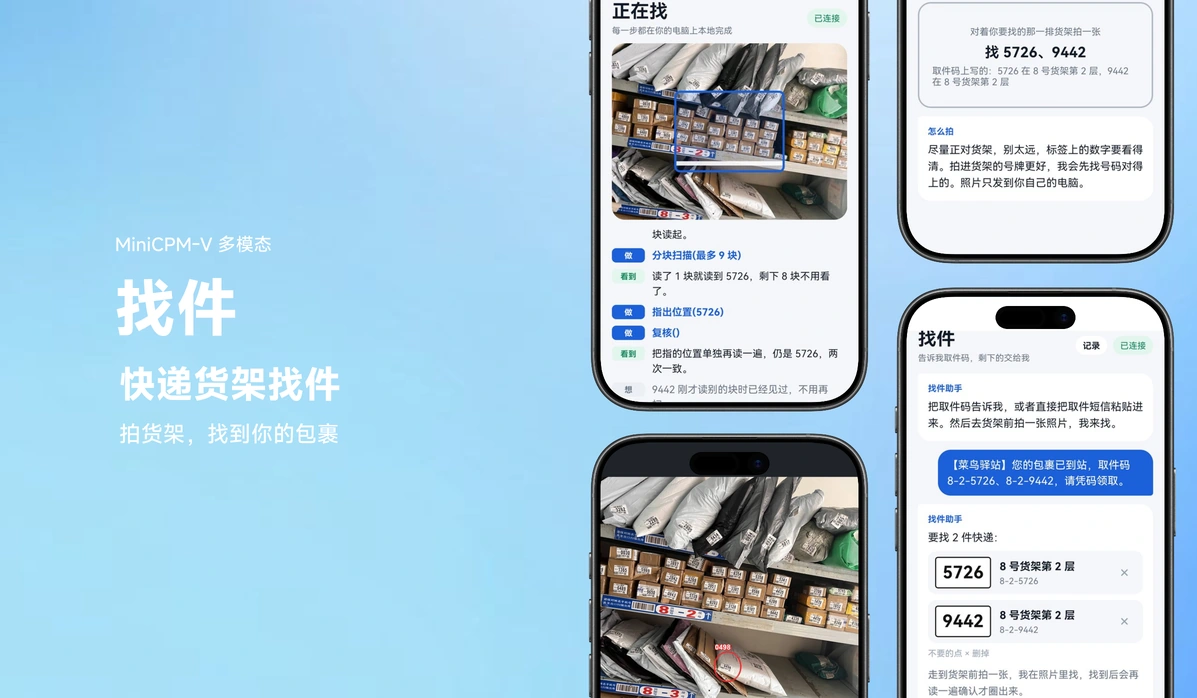
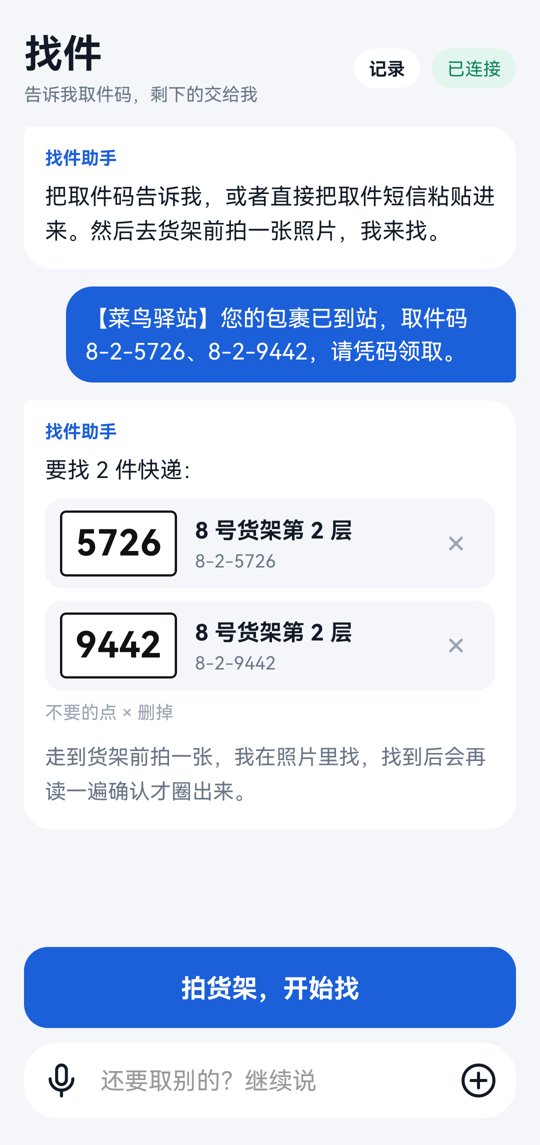
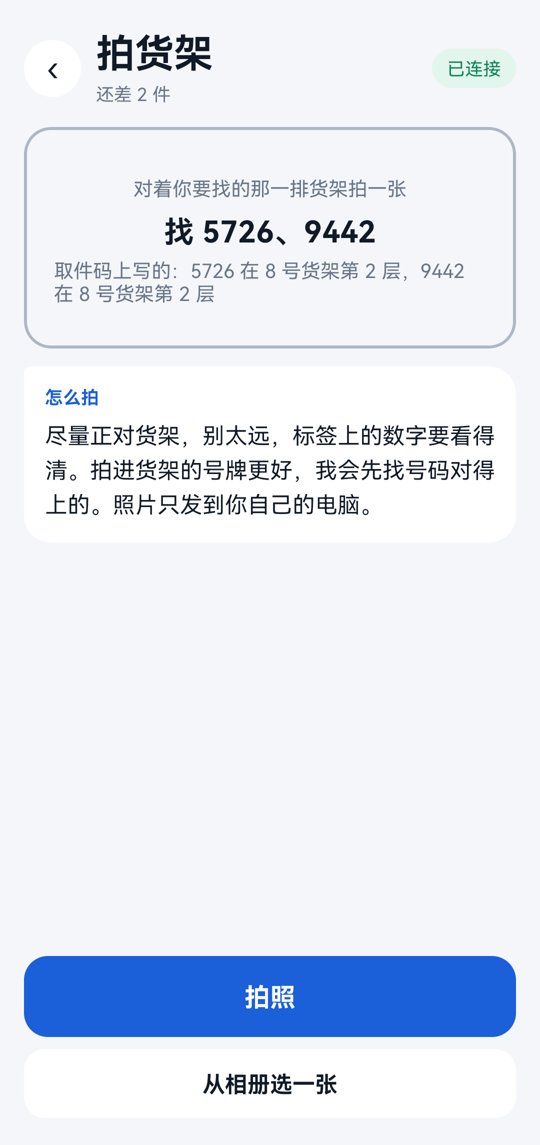
Tell it your pickup codes (type them, hold to speak, or share the pickup SMS screenshot), take a photo of the shelf, and it finds your parcels in the photo, circles them, and logs the pickup.
All recognition and reasoning run on MiniCPM-V 4.7 (1B) on your own computer, with no cloud model or recognition API. At home, the phone connects to the computer over LAN; outside, it connects back through a tunnel that only forwards traffic. Photos contain other people's pickup codes and labels, so they only go to your own computer.
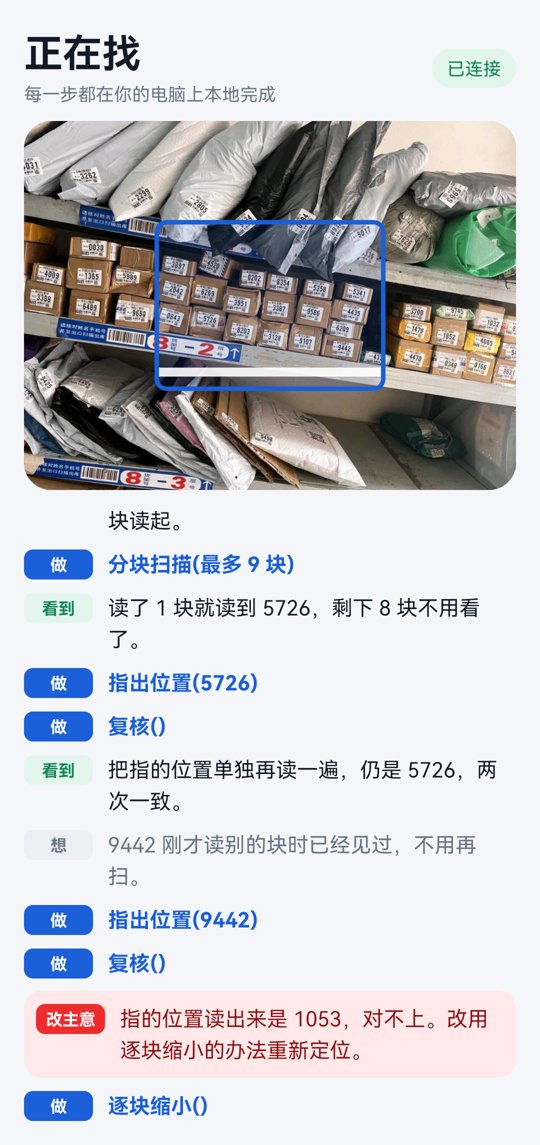
| Enter the codes | Shoot the shelf (or pick from gallery) | Watch it search step by step |
|---|---|---|
 |  |  |
The circled result:
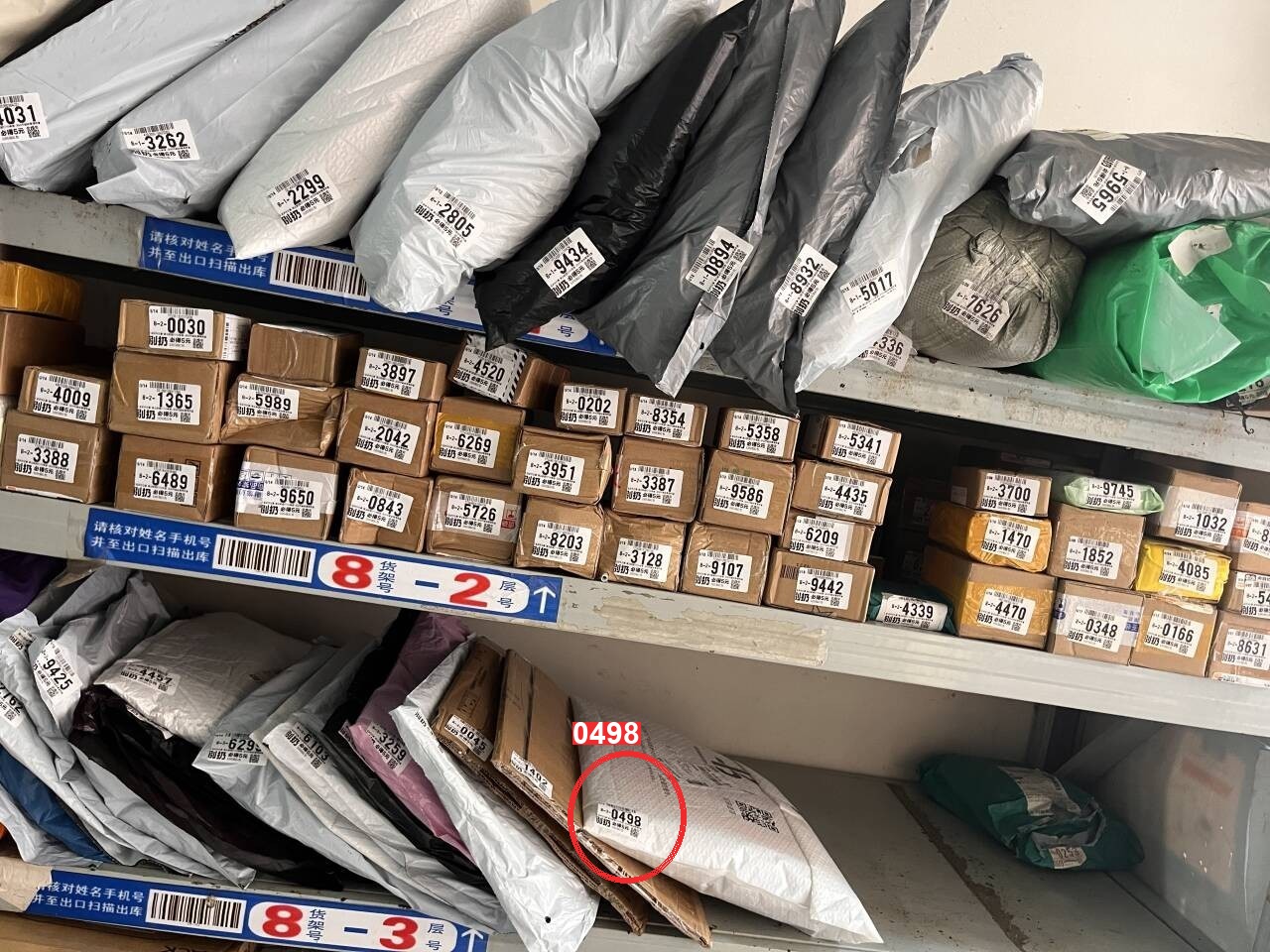
What MiniCPM Does
This isn't "call the model once and show the result". Each step of the agent depends on the model's previous output:
| Step | MiniCPM-V 4.7 output | What it decides |
|---|---|---|
| Understand the request | Pickup codes from text, speech transcript, or SMS screenshot | Which parcels to find; numbers after "verification code" or "phone" are ignored |
| Check the photo | Whether labels are readable | If not, stop and ask you to retake, no guessing |
| Read shelf signs | Which shelf and tier is in the photo | Matching parcels are searched first, others last (never refused) |
| Estimate position | Which region the parcel is likely in | Start from the nearest region and stop once found |
| Read labels | Codes visible in each region | Found or not, which region next |
| Point | Label coordinates within the region | Where to draw the circle |
| Verify | Re-read the pointed location | Circle only if both agree; otherwise change its mind: split the region into four and search near the miss |
| Not found | Closest codes in the photo | Whether you misread a digit or the parcel isn't on this shelf |
The phone UI streams these steps live as think / act / see / change mind / ask you, and the scan box follows where the agent is looking. In the third screenshot above, after pointing at 9442, verification read 1053, so the agent changed its mind and relocated. That was a real run.
Shelf and tier number comparisons are done in code: in testing, the 1B model was unreliable at comparing numbers, but reliable at perception (reading, judging, pointing). The work is split accordingly.
Results
On a Windows laptop with an RTX 3060 Laptop GPU (6 GB VRAM), running Q8_0 via llama.cpp:
- Reading: of 53 fully visible codes counted by hand on the sample shelf photo, MiniCPM-V 4.7 read 52 correctly by region (MiniCPM-OCR 1.0: 51).
- One parcel: about 6 model calls, 8–11 seconds.
- Two parcels:
8-2-5726+9442both found in one photo, 12 calls, 19.1 seconds. - Relocating after a miss: in a real error (looking for 9107, verification read 1234), the old region-by-region narrowing took 16 calls and 23.2 seconds; "split into four, read nearby, re-point in a small area" took 9 calls and 15.4 seconds, with the correct circle.
- Blurry photo: judged unreadable; the agent asks you to retake instead of giving a wrong position.
- Footprint: 1.1 GB model + 0.86 GB vision projector,
--ctx-size 4096.
Voice input uses SenseVoice-Small, which transcribed all 11 test recordings correctly at 0.1–0.4 s each. Speech recognition is not MiniCPM; it only turns speech into text.
These numbers come from the author's tests on sample photos. The pickup codes in the samples are fictional.
Architecture
Phone app (uni-app x: Android / HarmonyOS)  ─┐
Browser page web/index.html                 ─┼─ LAN / tunnel ─→ server/server.py ─→ llama-server
                                             │                  (agent logic in       (MiniCPM-V 4.7 1B)
                                             │                   server/agent.py)
                                             └─ Voice: SenseVoice-Small (sherpa-onnx), also local
Run It
1. Start the model. Download llama.cpp and the MiniCPM-V 4.7 1B GGUF files (MiniCPM-V-4_7-1B-Q8_0.gguf and mmproj-model-f16-4x.gguf):
llama-server -m MiniCPM-V-4_7-1B-Q8_0.gguf --mmproj mmproj-model-f16-4x.gguf \
  --host 127.0.0.1 --port 18500 --alias minicpm-v --ctx-size 4096 -ngl 99
2. Start the agent service (Python 3.10+):
pip install -r requirements.txt
cd server
python server.py --port 18600 --key your-own-passphrase
The service listens on 0.0.0.0, so phones on the same LAN can connect. To use it outside, expose port 18600 with a tunnel such as frp or cpolar. The service is then public, so always set --key and prefer an https tunnel.
3. Use it. Open http://<computer-LAN-IP>:18600/?key=<passphrase> in a browser for the web version, or open app/ in HBuilderX and run it on an Android or HarmonyOS device.
Design Trade-offs
- Accepts any code format:
8-2-5726,12-6029, or just the last four digits5726. Shelf numbers only set the search order; the agent never refuses because a shelf sign doesn't match. - No example codes in prompts: in testing, both the 1B model and Whisper echoed example numbers from the prompt as if they had seen or heard them.
- Estimate first, read by region, stop when found: pointing on the whole photo is off by one parcel; reading by region, pointing within the region, then re-reading is both accurate and faster.
Known Limitations
- The 1B model can misread or miss labels that are tiny, heavily angled, or half-covered. In that case the agent lists the closest codes for you to check.
- Outside use requires your own tunnel and a running computer. Tunnel providers relay traffic, including photos; use self-hosted frp or an https tunnel if that matters.
- HarmonyOS builds need DevEco Studio configured in HBuilderX; iOS is untested.
Links
- GitHub: worryzyy/zhaojian