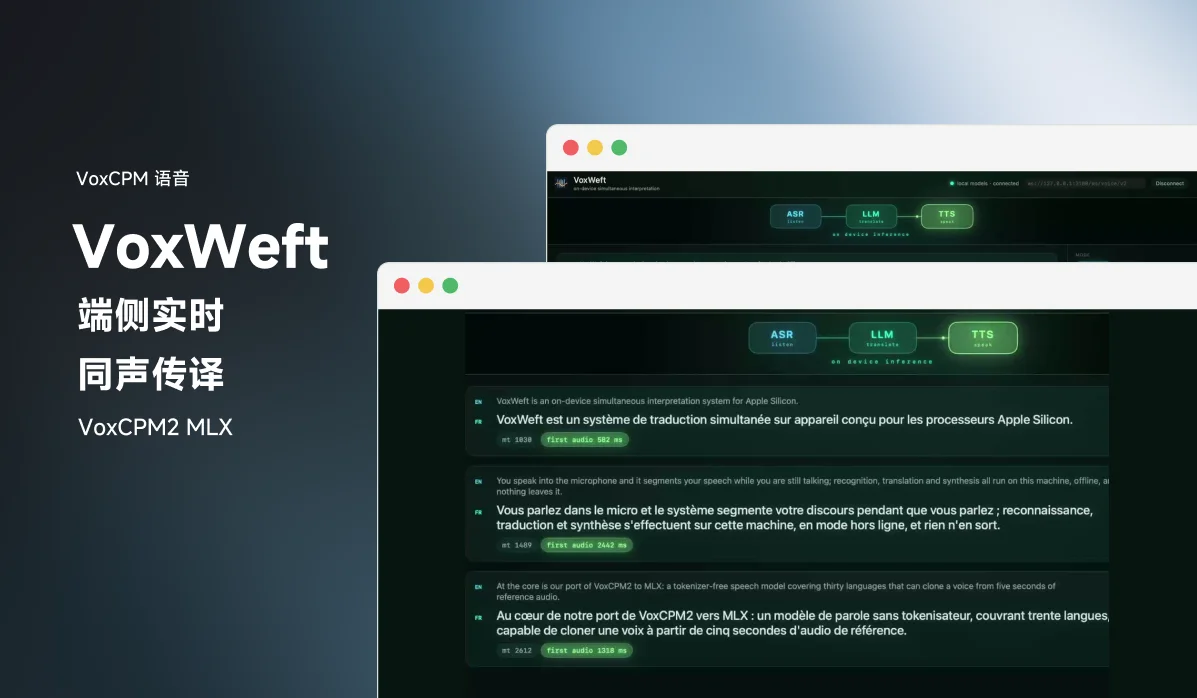
VoxWeft is on-device simultaneous interpretation on Apple Silicon: speech in, translated speech out, streaming — nothing leaves the machine. At its core is the author's port of VoxCPM2 to MLX.
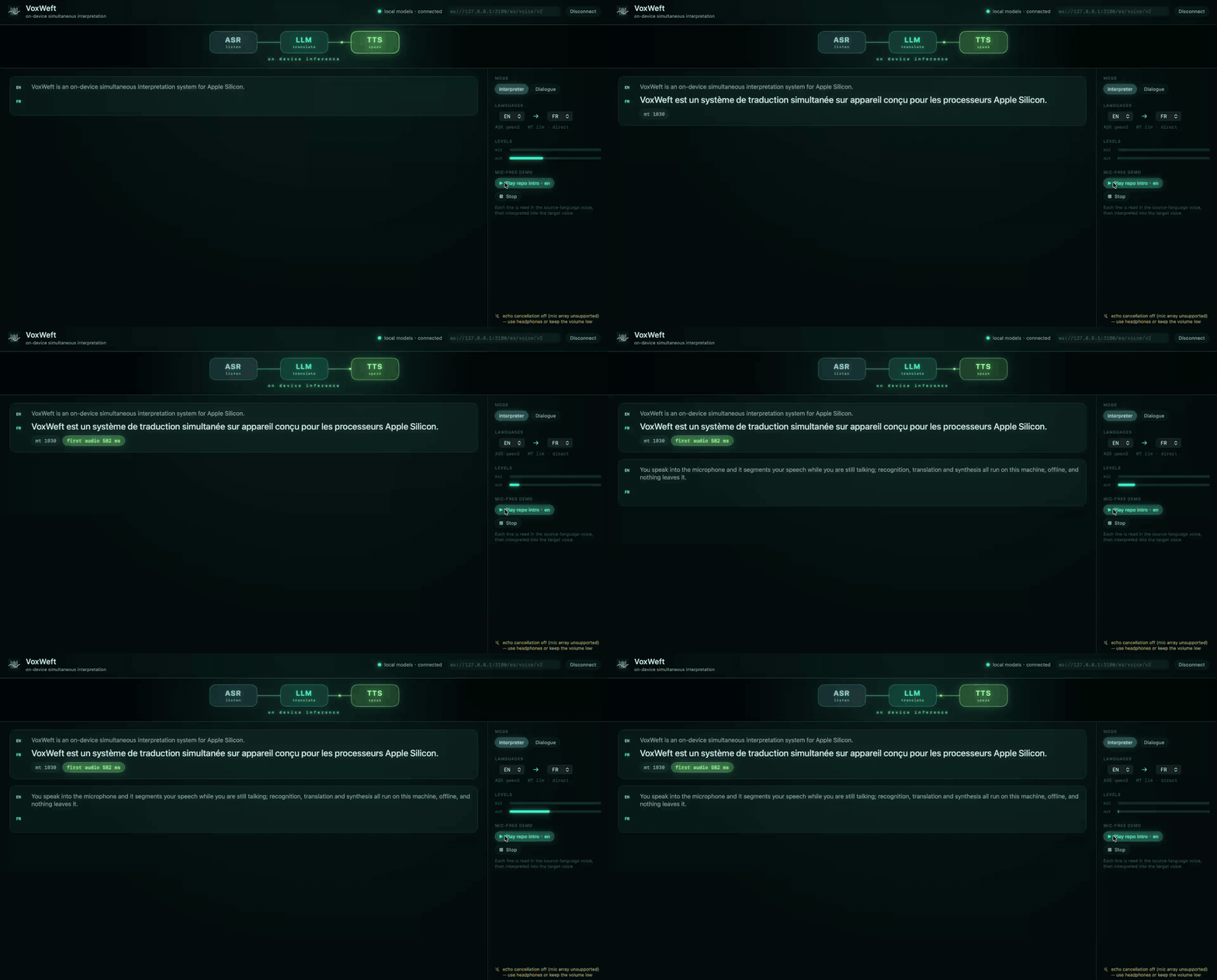
English → French on a MacBook (M5), no microphone: each line is read in a designed source voice, then interpreted into the target voice. The dashboard glows with whichever model is working.
Overview
At the core is a port of VoxCPM2 — a 2B tokenizer-free TTS covering 30 languages — to MLX:
- zero weight conversion for the LM, bit-exact AudioVAE;
- a stateful streaming decoder that gets first audio out in ~170 ms on an M5, ~300 ms on a base M2, ~150 ms on M3 Ultra;
- voice cloning from ~5 s of reference audio;
- 4-bit quantization;
- verified module-by-module against the official PyTorch implementation.
Around it: a runtime that turns a microphone into segmented, translated, spoken output while the speaker is still talking — and a macOS shell that shows you which model is working, and how long each step took.
There is no PyPI or npm package, on purpose: the source is the distribution. Clone, install editable, point your agent at the clone.
git clone https://github.com/HenryZ838978/VoxWeft && cd VoxWeft
python -m venv .venv && source .venv/bin/activate
pip install -e .              # L1: TTS, clone, `voxweft say`
pip install -e ".[mcp]"       # + MCP server for agent harnesses
pip install -e ".[runtime]"   # + segmenter, ASR/LLM adapters, WebSocket server
If you are an agent (Claude Code, Codex, Cursor, …) setting this up for a user, read docs/AGENT-SETUP.md — it is written for you.
Three layers, one repo
              ┌──────────────────────────────────────────────────────┐
   L3         │  CLI  ·  MCP server  ·  macOS shell (app/)           │  wrappers — thin, replaceable
              └──────────────────────────────────────────────────────┘
              ┌──────────────────────────────────────────────────────┐
   L2         │  segmenter / endpointing  →  ASR  →  MT | LLM        │  runtime — MLX only,
   runtime    │  language router · orchestrator · /ws/voice/v2       │  models are yours to pick
              └──────────────────────────────────────────────────────┘
              ┌──────────────────────────────────────────────────────┐
   L1         │  VoxCPM2 on MLX: streaming VAE · clone · 4-bit       │  core — ours end to end
   core       │  `voxweft say`                                       │
              └──────────────────────────────────────────────────────┘
L1 is the reason this repo exists. It is complete, tested against goldens, and useful on its own — any agent harness can get a local voice through the MCP server in one JSON block.
L2 is Lego. Two defaults ship for each of ASR and LLM, along with the adapters to plug them in, but you download the weights. Everything runs on MLX; Ollama and other CPU-first runtimes are not supported because they cannot hit the latency budget on this hardware.
L3 is whatever fits. CLI, MCP, and a ~700-line SwiftUI shell in app/ with hold-to-talk, a live ASR → LLM → TTS dashboard, per-turn latency chips and a mic-free demo. Disposable by design.
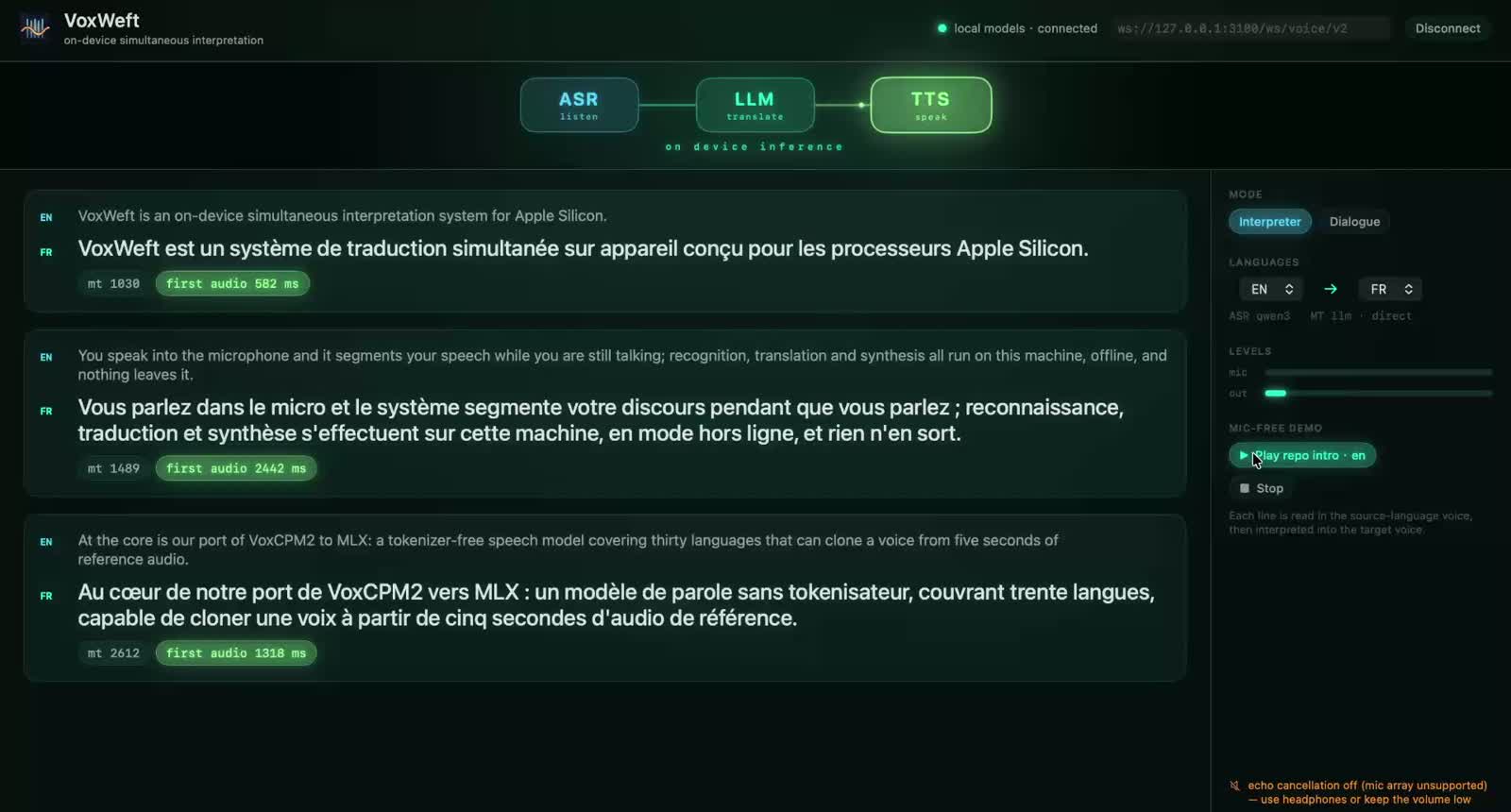
Each card is one segment: source line, interpretation, and what it cost — mt is the LLM, first audio is measured from the moment the text reached VoxCPM2 to the first sample the speaker played.
Quick start — L1
export VOXCPM2_MODEL=~/.voxweft/models/VoxCPM2      # see docs/MODELS.md
python scripts/convert_vae.py $VOXCPM2_MODEL        # one-time, audiovae.pth → MLX

voxweft say "你好,欢迎使用语音合成服务。" --play
voxweft say "Guten Morgen, wie geht es Ihnen?" --stream -o out.wav   # prints first-audio ms
voxweft say "ສະບາຍດີທຸກໆທ່ານ" --ref my_voice.wav -o lao.wav          # clone from ~5 s
from voxweft.core import VoxCPM2Pipeline

pipe = VoxCPM2Pipeline(model_dir, inference_timesteps=6, quantize_lm=4)
for chunk, i in pipe.generate_streaming("text", ref_latents=pipe.encode_reference(ref_16k)):
    play(chunk)                       # float32 @ 48 kHz
MCP, for Claude Code / Codex / Cursor / anything that speaks MCP — point the harness at the venv inside your clone, no global install. Works with the mcp Python SDK 1.x and 2.x (2.x renamed FastMCP; the server adapts):
{"mcpServers": {"voxweft": {
    "command": "/path/to/VoxWeft/.venv/bin/voxweft", "args": ["mcp"],
    "env": {"VOXCPM2_MODEL": "/path/to/models/VoxCPM2"}}}}
Quick start — L2 runtime
Two processes. The bridge owns the MLX models for TTS and ASR, each pinned to its own thread (MLX GPU streams are thread-bound — see the devlog). The server owns segmentation, routing, the in-process MLX LLM/MT, and the WebSocket.
pip install -e ".[runtime]"
export VOXWEFT_MODEL_DIR=~/.voxweft/models         # VoxCPM2/, Qwen3-ASR-1.7B-8bit/, <llm>/
export VOXWEFT_LLM_DIR=$VOXWEFT_MODEL_DIR/Qwen3-4B-Instruct-2507-4bit
export VOXWEFT_VOICE_DIR=samples/voices          # <lang>_tgt.wav → the interpreter's voice per target language

voxweft bridge --port 8133 &      # wait for GET /ready → 200
voxweft serve  --port 3100        # ws://localhost:3100/ws/voice/v2
The protocol is in the docstring of voxweft/runtime/server.py: session_config, ptt_start, int16 PCM frames, ptt_end; back come asr, translation, audio_start + 48 kHz PCM chunks + audio_end, turn_end, and no_speech with the measured level when nothing was cut.
Default models
| slot | default | alt | licence |
|---|---|---|---|
| TTS | VoxCPM2 (4-bit) | — | Apache-2.0 |
| ASR | Qwen3-ASR-1.7B 8-bit via mlx-audio (zh/en/vi/th/id/ms + 20 more) — 2.5 GB, RTF 0.11, transcripts identical to bf16 on the test set | bf16 (4.1 GB) · 0.6B | Apache-2.0 |
| ASR, lo/km/my | whisper-large-v3-turbo (MLX) — routed automatically; quality is poor (Lao often comes back in Thai script) | Omnilingual-ASR CTC via sherpa-onnx is the better open option (adapter not written yet) | MIT |
| LLM / MT | Qwen3-4B-Instruct (mlx-lm) | Qwen3-8B · Hy-MT2-1.8B | Apache-2.0 |
| MT fallback | NLLB-200-1.3B | — | CC-BY-NC-4.0, opt-in, research only |
No model weights are in the repo. docs/MODELS.md has download notes (ModelScope mirrors where HF is slow).
What the runtime does that a model download doesn't
- Cuts while you speak. Per-frame RMS with an adaptive noise floor, 0.45 s silence rule, forced cut at the first ≥100 ms dip after 6 s (hard cut at 9 s), and a carry buffer so a 0.4 s "So," is prepended to the next segment instead of silently dropped. Learned end-of-turn (SmartTurn v3) is wired in and off by default — the author measured it net-negative for interpretation and explains why.
- Routes by language pair, no pivot. Any pair goes straight through the LLM — es→ms, de→vi, ja→fr are one hop, never via Chinese or English. Only low-resource targets (lo/km/my) go to dedicated MT, because a 4B chat model guesses the wrong script when asked to write them.
- Keeps MLX alive under concurrency. Thread-pinned executors, no locks across
yield, warm-up through the same code path as requests. Each of those is a crash that actually happened. - Interrupt actually interrupts.
ptt_startor Stop cuts the client stream, cancels the in-flight turn, and shuts the socket to the TTS so the bridge stops synthesizing within one patch — next sentence in ~1 s on M2 instead of queuing 20 s behind a dead one. - Reports failure loudly. A press with no segment returns
no_speech {peak_rms, threshold, too_quiet}so "nothing said" and "too quiet" can be told apart on the spot instead of in the server log.
Numbers
Measured on a base M2 16 GB with nothing else running (Lark, VPN helpers and stray Python killed first — with them resident the same pipeline was 3–4× slower and free memory was ~100 MB). M3 Ultra figures are from the stage build.
| stage, in isolation | M2 16 GB | M5 16 GB (MacBook) | M3 Ultra |
|---|---|---|---|
| VoxCPM2 4-bit TTS, first audio (warm) | 303 ms | 169 ms | 124–168 ms |
| VoxCPM2 4-bit TTS, RTF | 1.47 | 0.94 (with a full desktop session running) | ≈ 0.2 |
| Qwen3-ASR-1.7B 8-bit, 10 s clip | 1.2 s (RTF 0.11) · bf16: RTF 0.24 | — | — |
| Qwen3-4B 4-bit, one sentence zh→en | first token 405 ms · 16 tok in 870 ms | — | — |
| resident memory, all three | 6.7 GB (bf16 ASR: 8.5) | 6.7 GB | — |
end to end, /ws/voice/v2 | M2 16 GB | M5 16 GB | M3 Ultra |
|---|---|---|---|
| text → LLM → first interpreted audio, per sentence (the clip above, en→fr) | — | 0.58 / 2.4 / 1.3 s | — |
| segment commit → first interpreted audio (worker idle) | ≈ 2.5 s | — | ≈ 0.85 s |
| per-segment wall time, 5 s of speech out | ≈ 7 s | ≈ 5 s | ≈ 1.5 s |
| TTS ASR-round-trip CER, repo intro zh / en | 3.4% / 7.8% | ||
| segmenter, phone mic, ASR CER fixed→adaptive threshold | 16.3% → 10% |
On the M2 the pipeline is TTS-bound: RTF 1.47 means 5 s of speech takes 7 s to produce, and the serial worker makes the next segment wait. ASR and the LLM together are ~1.5 s and would keep up with real time; the TTS is the silicon ceiling (upstream measures the same RTF). On M3 Ultra all three are under real time and the pipeline streams.
BLEU is deliberately not published. Translation quality is the property of the model you plug in; what this repo owns is that the pipeline does not lose it on the way: ASR-round-trip intelligibility of the TTS, first-audio latency, and RTF. bench/ has the scripts.
Voices
No reference recordings ship. The showcase voices are designed: VoxCPM2's caption mode ((A mature man in his fifties, calm broadcaster voice, Castilian Spanish)…) generates candidates, a human picks one per language and role, and the pick becomes the clone reference the bridge uses for that target language. Convention: source speaker = mature male, interpreter = young female, same text in every language — the repo's own two-sentence introduction.
22 voices ship in samples/voices/ (11 languages × src/tgt) and are registered in voxweft.db — a single SQLite file that is the runtime's default configuration: voices, the intro text per language, and the showcase route matrix. The bridge installs every voice from it at start-up; nothing to configure. python -m voxweft.db show dumps it.
To design your own:
python scripts/design_voices.py --langs de,fr --n 3 --out /tmp/cands
# listen, mark "pick": true in /tmp/cands/manifest.json, then
python scripts/pick_voices.py /tmp/cands && cp /tmp/cands/*_{src,tgt}.wav samples/voices/
python -m voxweft.db build
samples/voices/<lang>_src.wav is also the microphone stand-in for demos: scripts/mock_interpret.py --wav samples/voices/es_src.wav --src es --tgt ms streams it through the real PTT path at real-time pace — segmenter, ASR, MT, TTS — with no microphone.
The devlog is part of the product
docs/DEVLOG.md records every failure hit, what the author was wrong about, and what it cost: MLX stream thread binding, a lock held across an async yield that froze the process, temperature that is not a temperature, text that the model dutifully read aloud, SwiftPM "building" in 2.8 s without compiling, SwiftUI Button aborting on macOS 26, a learned endpointer that made interpretation worse. A working demo can be regenerated by any model; this list cannot.
Layout
voxweft/
  core/        model.py · vae.py · generate.py · cli.py          L1
  runtime/     segmenter · router · orchestrator · translator     L2
               bridge.py (TTS+ASR HTTP) · server.py (WebSocket)
  wrappers/    mcp_server.py                                      L3
app/           SwiftUI macOS shell (hold-to-talk, latency chips, demo)  L3
tests/         golden alignment (needs model) · segmenter · router · orchestrator (no model)
bench/         asr / mt / tts benches + ASR-round-trip judge
scripts/       convert_vae.py · probe_{onset,stream,clone,perf}.py · mock_interpret.py
docs/          DEVLOG.md · TTS-FINDINGS.md · ARCHITECTURE.md · HARDWARE.md · MODELS.md
samples/       zero-shot zh / lo output, round-trip verified
Credits
- OpenBMB/VoxCPM — the model. Tokenizer-free turned out to be exactly right for low-resource languages: no RVQ codebook to be out-of-distribution on.
- ml-explore/mlx — the array framework that made the port a one-day job (and the debugging a two-week one).
- Qwen3-ASR, mlx-lm, mlx-audio, pipecat SmartTurn — the Lego.
Licensed under Apache-2.0.
Links
- GitHub: HenryZ838978/VoxWeft
- Full demo clip: docs/media/showcase.mp4 (70 s, 1.6 MB)
- Author: HenryZ838978